Wanderful Loves
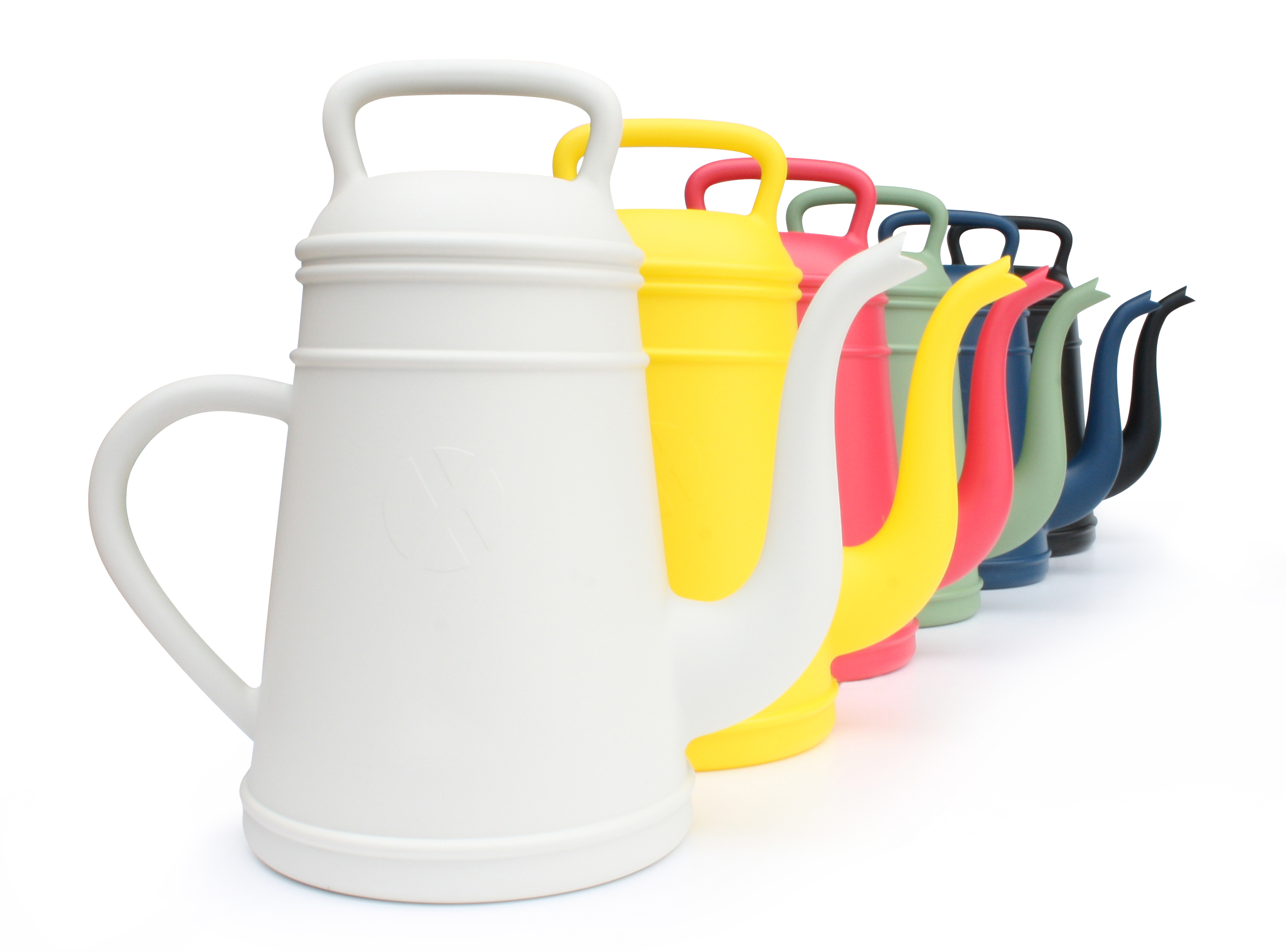
A hundred thousand. That is how many Lungo watering cans stand in gardens from Porto to Prague, from suburban terraces to royal greenhouses. Queen Mathilde has one. So does Willem-Alexander. “Or at least, they were given one at some point,” says Davy Grosemans. “There are photographs, anyway.”
This is not about the watering can. It is about what happens when you send the same object into the world a hundred thousand times and wake up one morning realising you would rather make something different twelve times over.
The playground wears thin
Grosemans graduated as a product designer from the MAD-faculty in Genk in 1999 and joined Creneau International that same summer — the Hasselt agency that exports interior and brand architecture from Brussels to Dubai. He stayed. For more than twenty years. In parallel, in 2001, he founded Das Ding, his own studio for what he calls “nice mass products”. The FrouFrou — a clean-lined parasol that made the kitsch raffia version forgettable — won him an iF Product Design Award in 2008. The Chubby, an industrial fluorescent tube inside an upholstered lampshade for lighting house Dark, became a commercial hit alongside the FrouFrou at Sywawa. Two manufacturers that grew on his drawing table.
And then there was the Lungo. A watering can shaped like an enamelled coffee pot from the twenties. Twelve litres. Grosemans had almost not shown the sketch. “I walked into Xala with a whole stack of ideas and a big design ego — I had just put a few winners behind my name. One by one, they liked none of it.” He threw the watering can onto the table to rescue the meeting. The Lungo became his biggest hit: more than a hundred thousand units, all across Europe, and later North America too.
But the fun wears thin. “Hawking sketches around still has something challenging about it,” says Grosemans. “But the drawn-out aftermath of getting a product idea into production and onto the market… that is excruciating, often.” The friction is not in the designing. It is in everything that follows: the moulds, the certifications, the logistics chain, the margins. The object that leaves the drawing table as an idea arrives at the consumer as a compromise.
Objects in search of meaning
In 2022 Grosemans launches ÆTHER/MASS. No agency. No client. A label with a single rule: editions of twelve, signed and numbered, and never more than that. The tagline — Objects in search of meaning — reads like a manifesto but works as a working agreement. Every object has to say something beyond its function. No chair that merely carries. No lamp that merely gives light.
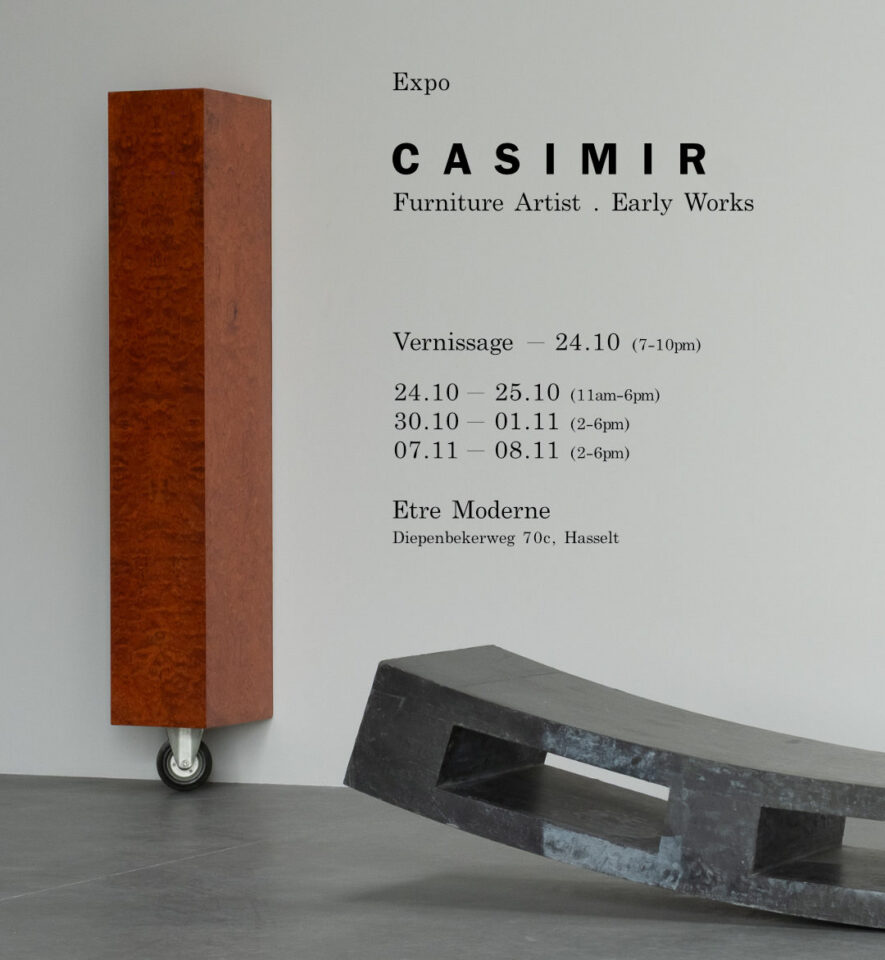
The launch counted seven objects: a lighting piece, a chair, two bowls and a family of three plinths that double as stools or side tables. Sculptural and architectural at once, as if they would sit as easily in a gallery as in a living room. He made the wooden pieces together with furniture maker Casimir, the lamp in close consultation with Wim Roggeman. Jean Van Cleemput photographed the launch collection.
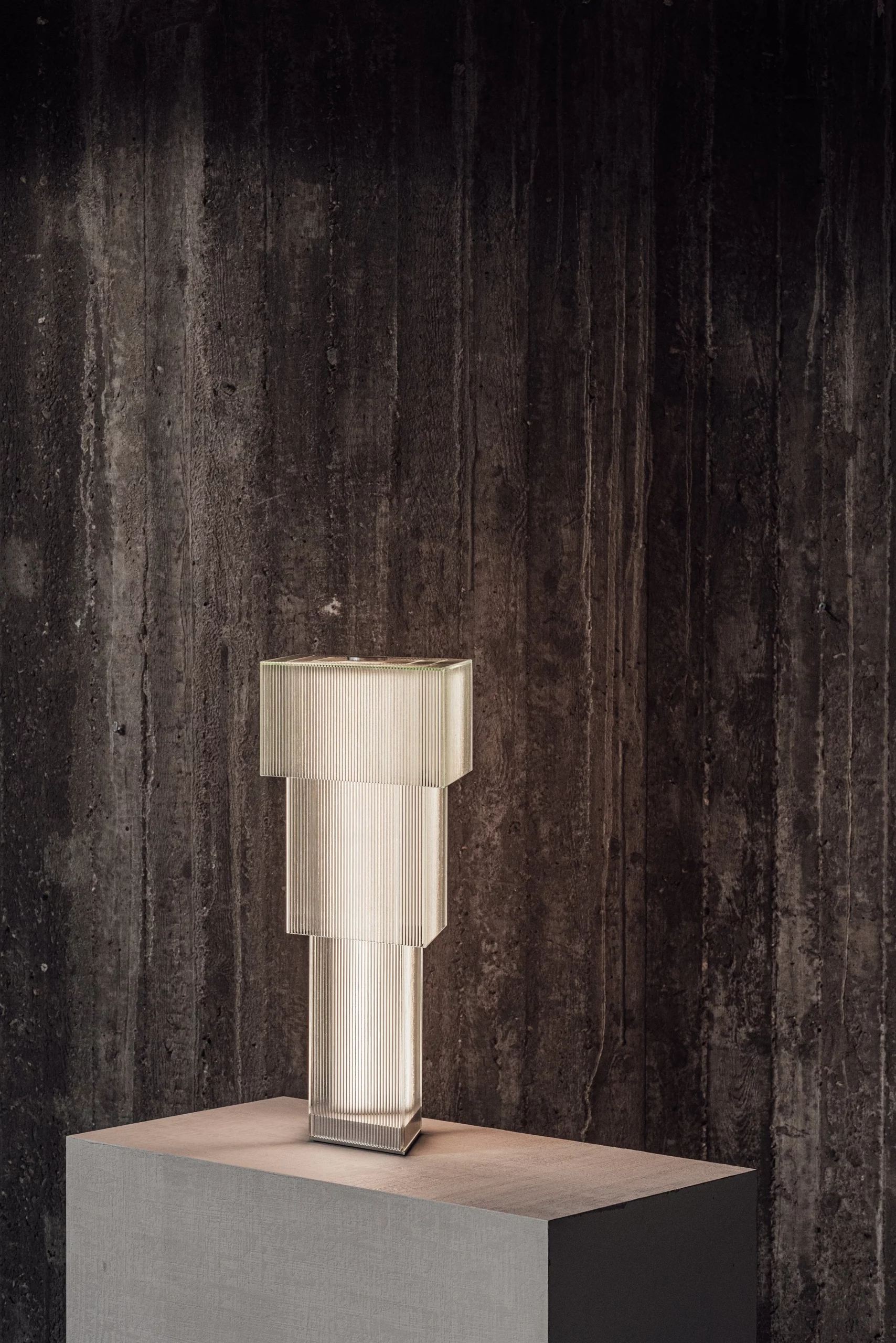
Four years on, the range counts nineteen objects. The Shroud — a table lamp from 2025 — consists of three layers of ribbed glass, made by glassmaker Wouter Lievens. The light breaks through the overlapping textures and creates patterns that shift with every angle. Vincent Verheyen built in the technology. Edition of twelve, plus one proof edition. No dimmer. No app. Glass, light, and what happens in between.
The apprentice
What stands out: Grosemans makes nothing himself. Not in the traditional sense. He designs, yes, but the execution lies with craftspeople — and that relationship is not a hierarchy of client and contractor. He describes himself as an apprentice in their workshop. Not as rhetorical modesty, but as method. The dialogue with the maker leads to insights the drawing table does not offer. An experiment in the workshop opens up a direction no sketch had foreseen.
It is a reversed movement. At Creneau and Das Ding he sent designs into the production chain and waited for whatever came out the other end. At ÆTHER/MASS he stands beside the person bringing the object into being. The watering can was a sketch that had to rescue a meeting. The Shroud is a conversation between a designer and a glassmaker that only stops when the light does what it has to do.
Beauty by accident
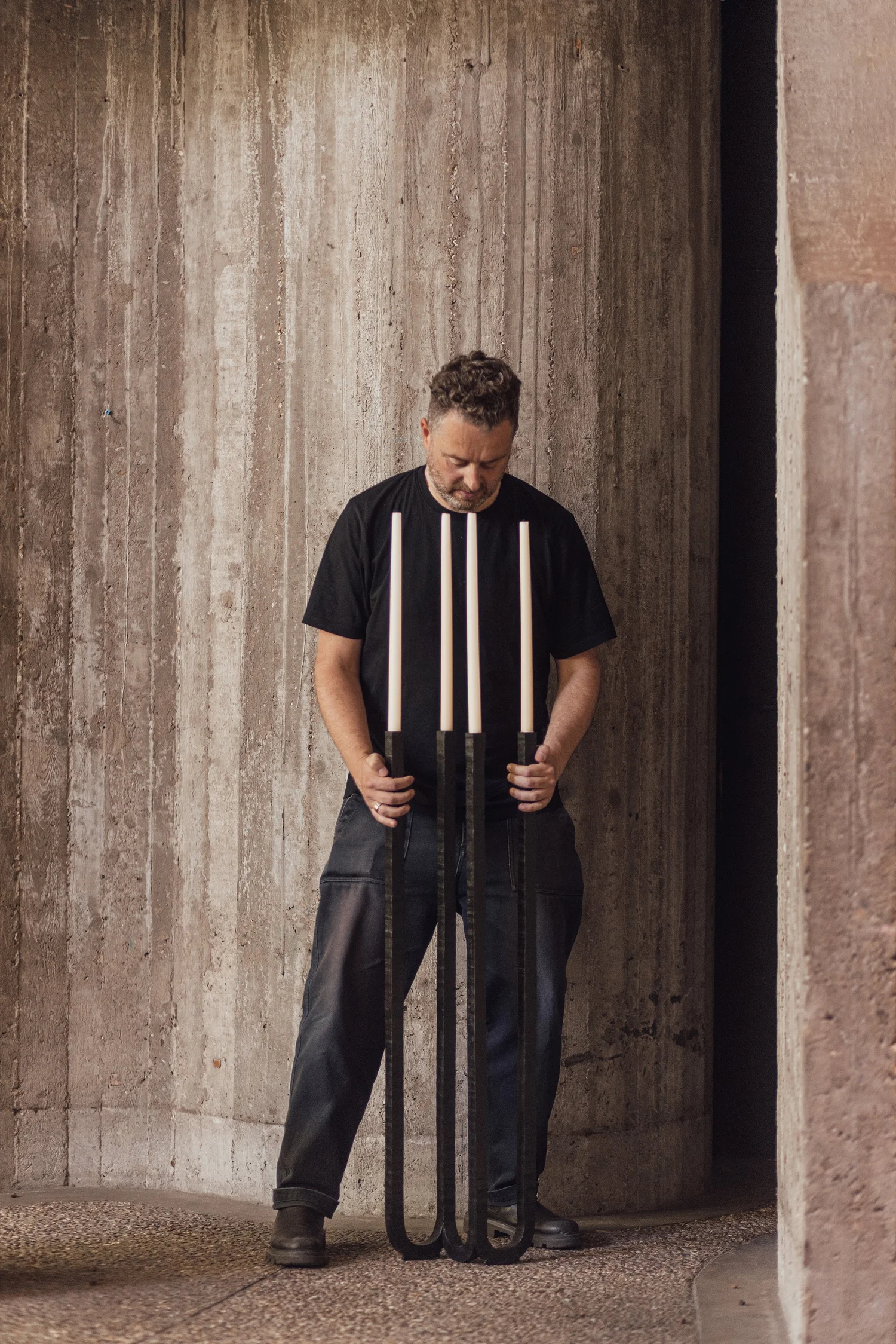
Grosemans calls it beauty by accident — beauty that arises as a by-product of function and craftsmanship, not as an aim in itself. It is the same logic that draws him to the objects he admires: utilitarian things born of necessity, where the aesthetic comes along almost by chance. A wooden bowl that is beautiful because the lathe left no other option. A candelabra that is elegant because that is how wrought iron cools.
That philosophy also explains why ÆTHER/MASS has no catalogue in the usual sense. The objects are not categorised by function — lighting, seating, accessories — but presented as a collection that grows at the rhythm of the conversations with makers. Remembering Carl Andre next to the Parabole Chair next to the Forge Candelabra. No line. An archive of encounters.
Twelve
A hundred thousand Lungos in a hundred thousand gardens. Twelve Shrouds on twelve tables somewhere in the world. The numbers say nothing about value and everything about choice. Davy Grosemans chose twelve. Not out of exclusivity. Out of the freedom to let the next object be something else entirely.
In March 2026, ÆTHER/MASS showed at COLLECTIBLE in Brussels — the fair where design and art meet. From a Hasselt drawing table to a Brussels fair floor, twelve pieces at a time.
Wanderful Loves
Related Articles

Magazine › Report, Story
Mijn verleden
“The moment the mines closed, it was as though the…

Magazine › Interview, Story
The power of six
We look at the creative minds, those who have had…